
The Phoenix Coat: A CVD Traveler’s Tale
Author’s Note:
This piece is different than my usual writings about CVD and pacemakers, as it discusses my travels with a cardiovascular illness and the physical differences/consequences of my surgeries
It started 13 years ago in college, when I had a deeply impactful dream, but I had no idea how meaningful it was, even to this day, especially considering my current circumstances.
One night, when I was finishing up the first semester of my Bachelor’s degree, I woke up with a start in the darkness of my small dorm room. Grasping my chest, it took a moment to catch my breath, all while trying to make certain not to wake my roommate, whom I realized had finally returned from her frat party. But thankfully, she remained asleep.
I took a deep, steadying breath in the darkness, reveling in the dream I had just experienced.
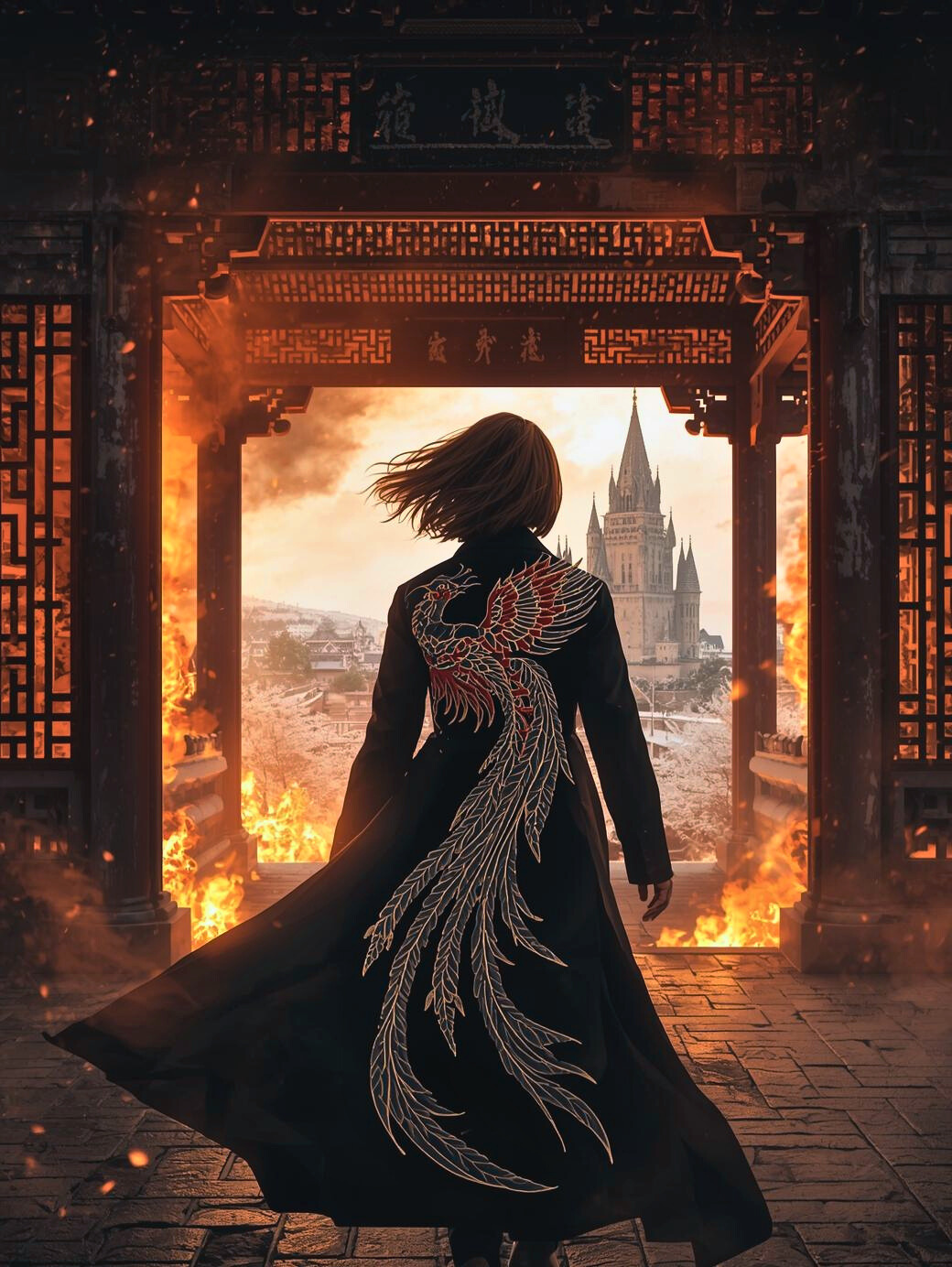
It began with me sitting in the living room of my dorm when I spotted a shadow out of the corner of my eye. I investigated and spotted a woman with short brown hair and a black coat walking down the hallway. Curious, I followed her until, all of a sudden, she walked through a red-lacquered, intricately carved archway that magically appeared and into an ancient palace in Chang’an (Xi’an), a place where I was told I would need to study if I took the Chinese route of his program. The floors were polished black stone, and the columns were painted red, dangling with red and gold streamers hanging from the painted ceiling, where a figure I recognized from my previous research on the Three Kingdoms Period, Zhuge Liang (The Sleeping Dragon), walked out and called the woman by the name my professor had given me, “孟宝兰” (Meng Bao Lan) which meant “Treasured Orchid.” A white feather fan clutched in his poised hand.
Suddenly, the black coat began to glow, and a dazzling, majestic phoenix whose wingspan and tail feathers blossomed to cover the back of the garment in its golden light. Nodding to each other, the two figures walked together toward the palace balcony.
That was when the woman paused and began to pivot toward me, and all of a sudden, I woke up.
This dream was inspired by the fact that I had recently joined the newly founded Asian Studies degree program. By doing so, I became a double major and knew I would eventually graduate with two bachelor’s degrees in Anthropology and Asian Studies, along with minors in History and Chinese language (Mandarin. All because the head of the department sought me out and asked me personally to join the program.
Now, there were a few things that should be noted about this dream. The first was that my hair had always been long and often got me the nickname of being “the little Christian schoolgirl” among my roommates. I also had never owned a long black coat like that. Also, the name, “Meng Bao Lan” has the surname of “Mencius” and the given name meaning “Treasured Orchid.” My professor explained that the Lan is an unconventionally beautiful flower, but is better known as a scholarly flower. So, I loved that name with all my heart.
So, at the time, I thought it was a particularly vivid, perhaps even significant dream. Usually, I don’t put much stock into spiritualism as I try to be objective in all things. However, this dream was different, and it changed my life.
I began the Asian Studies program, studied in Xi'an for three summers, and traveled the country. As a consequence of the heat and humidity, I cut my hair and traveled to countless museums, temples, and heritage sites around the country. I ultimately graduated with both degrees.
After graduating, I worked at a local museum in Colorado, but when I submitted my painstakingly detailed and researched exhibition design for the “open and inclusive” contest, I gave it to a “work friend” and found it in the garbage right outside the door. They were never even going to look at it because I didn’t have a master’s degree.
Yet. Challenge accepted.
For the next ten years, I set about earning that master’s degree.
For most programs, I needed to get more foreign work experience to be considered. So, I returned to work in Shenzhen, China, for two years.
However, previously, my concern had been asthma symptoms. But, without the rose-tinted glasses of academia, this experience offered a slew of new challenges. The whole time, I faced discrimination for being female, American, Caucasian, and, most importantly, for my short arm (which was a result of my first open-heart surgery).
This is because I was considered to be and labeled a “canji.” In order to understand this we need to look into a cultural concept in China that is instilled by the three main traditional philosophies: Buddhism, Daoism, and Confucianism. All of them contribute to the idea of a “残疾” (canji) or (残疾人) (canjiren). They mean “disabled person,” but the true depth of the meaning is rooted in the country's traditional philosophy. According to the article, Disability and the Three Traditional Chinese Belief Systems – ChinaSource by Bobby Twosticks, “until recent decades, Chinese society labeled individuals with disabilities as canfei ren, literally ‘disabled garbage people.’ Now, the official term is canji ren, literally “disabled sick people,” although the Chinese government removes ‘sick’ when providing an English translation. Numerous citizens will avoid canfei or canji all together and say ‘the person who cannot see’ or ‘the person who cannot walk,’ which is the Chinese equivalent to ‘person first language.’ At least verbally, the situation in China for individuals with disabilities is improving. However, discrimination is still rampant. The question is why” (TwoSticks, 2016). It is because “every action—whether good or bad—stems from belief. Beliefs form stereotypes which in turn lead to prejudice and discrimination (Ditchman et al.). The article discusses how Buddhism, Taoism, and Confucianism contribute to the treatment of people with disabilities.
The article describes how “most devout Buddhists believe that people can find a path to supreme enlightenment (Lam et al., 2010). A Buddhist disability scholar, Darla Schumm (2010), calls this journey a “path of compassion,” which encompasses interdependence. All objects and people are dependent on each other. Accordingly, “suffering and healing are simultaneously opportunities for offering and receiving compassion”(Schumm (2010), p. 133). She argues that a good Buddhist will give, forgive and deliver Buddha’s teachings to others while trying to reduce suffering. From this perspective, Buddhists should treat people with disabilities well, and in fact, there are many Buddhist groups in China that are serving families affected by disability (TwoSticks, 2016). So, since “Buddhism sees disability as a punishment for past wrongdoings. In this thinking, a reincarnated man with a disability indicates a man who deserves punishment. Many researchers have concluded that this understanding intensifies stigma and discrimination” (TwoSticks, 2016). In terms of Taoism, “Taoists believe humans should be in harmony with nature and with each other in an uncertain world with changing ambiguities. Disability results from “a disharmonious fusion of nature and man” (Lam et al., 2006, p. 274)” (TwoSticks, 2016). And for Confucianism, “disability advocates are most troubled by Confucianism (Lam et al., 2010), which is regaining prominence in China. Confucianists believe that social order and harmony overpower everything else, even at the expense of one’s own opinions, beliefs or values (Lam et al., 2006)” (TwoSticks, 2016). However, in terms of how this relates to the treatment of those with disability, ‘This social idea opposes Western individualism. It directly relates to the concept of ‘face’, which has been the focus of much stigma research. There is no direct Western equivalent—and therefore vulnerable to being misunderstood—but ‘face’ involves social worth, reputation and image as it relates to both personal and social relationships in China. It mixes guanxi or formal relationships with strict rules of giving and receiving favors to build hierarchical social power (Lam et al., 2010). The more power one has, the more that person will have “the capacity to modify others’ states” (Greer & Kle, p.1032). A faceless individual or group is powerless to interact with society. A disability or any other kind of deformity is a serious loss of face, damaging the social power of the family. ‘Thus the Chinese rule: honor one, honor all—disgrace one, disgrace all’ (Lam et al., 2010, p. 37)” (TwoSticks, 2016). As one can see, there is a deeply rooted ideal that sheds people with disabilities in a negative light, generically speaking.
However, neither I nor the author of the article wish this to be taken as a damnation of the culture, but more of an in-depth observation because “Buddhism, Confucianism and Taoism have had strong roots in China for thousands of years. These three interwoven belief systems strongly influence the Chinese collective culture, including society’s view of disabilities” (TwoSticks, 2016). The author’s goal of the article was “not to ‘fix’ these traditional Chinese beliefs or even to suggest a perfect understanding of their tenets. Rather, this article aims to encourage an honest dialog with humble sensitivity. To combat prejudice and discrimination against disabilities in China, all parties must come together, unified in purpose and compassion” (TwoSticks, 2016). This is a hopeful sentiment and one day I hope it comes true.
However, this was not my experience in China, because basically, being labeled a canji meant that one was basically a free target for abhorrent behavior. Most of the time, they did not call me by my name, English, or the one my professor gave me. To them, my name was “canji” or some variation of it because I was often not considered a person.
I stayed, though, so that I could one day get my Master’s degree.
I remained as respectful as I could because, as someone who studies anthropology, history, culture, and heritage, I do what I can to be respectful of whatever culture I find myself in because even though it wasn’t made for me, I still want to understand the world around me. However, this was a challenge because this culturally enforced idea led to people following me, hitting me, jeering, calling me names, treating me as a sub-human at work, and multiple instances of robbery, sexual harassment, and sexual assault.
I survived, but I will admit that the experience made my heart turn cold toward the culture I once loved with all my heart.
But when it was over, I began my Master’s degree in Germany, where I hope to stay forever. I have since earned my degree, grown my hair long again, and become far more timid, all things considered. All because, although it was several years ago, but the experience in China drained my spirit and broke my soul into several jagged pieces. It took a long time to recover.
I am writing this because I recently had a sister-dream, similar to the one I had all those years ago.
It was the same woman in a long black coat with a phoenix on the back, walking through one of the magnificent, ornate gates of a traditional Qing-dynasty-style Chinese palace, similar to the designs I saw in the Suzhou Gardens and the Forbidden City… but it was consumed in a blaze around me.
In the dream, I calmly walked out of it into the icy winter of a German landscape—the silhouette of a winter-wrapped German village and castle in the distance with lights lit and Christmas trees aglow with festive cheer.
It was just a dream, but one that is significant to me. Someday I want to commission a coat like that. Not gawdy or cliche, but delicate, vibrant, and meaningful.
I am telling this story not just because it is personally significant to me, but because, in my experience, people with disabilities are treated differently in different places, which is a bit of knowledge that might help others. Sometimes it's better for some, sometimes it's worse for others. However, if I didn’t have a visibly crippled arm or asthma, it might’ve been better for me. But I’ll never know because I will never go back.
Perhaps it was a silly dream, or maybe it was prophetic, but the woman in the phoenix coat has been important to me for over a decade. It did not lead me to where I wanted to go. Actually, it led me through the fire to find myself where I needed to be.
If you have CVD (cardiovascular disease) or any chronic illness or disability, know that you are not alone, and oftentimes it is best to follow your heart through hard times so they lead you to better ones.
If you have any suggestions for topics regarding CVD, pacemakers, or my experiences traveling, please drop me an email.
#cvd #pacemaker #chronicillness #disability #travel #china #culture #heartdisease #dangers #dangers #cardiology #chronicillness #experience