
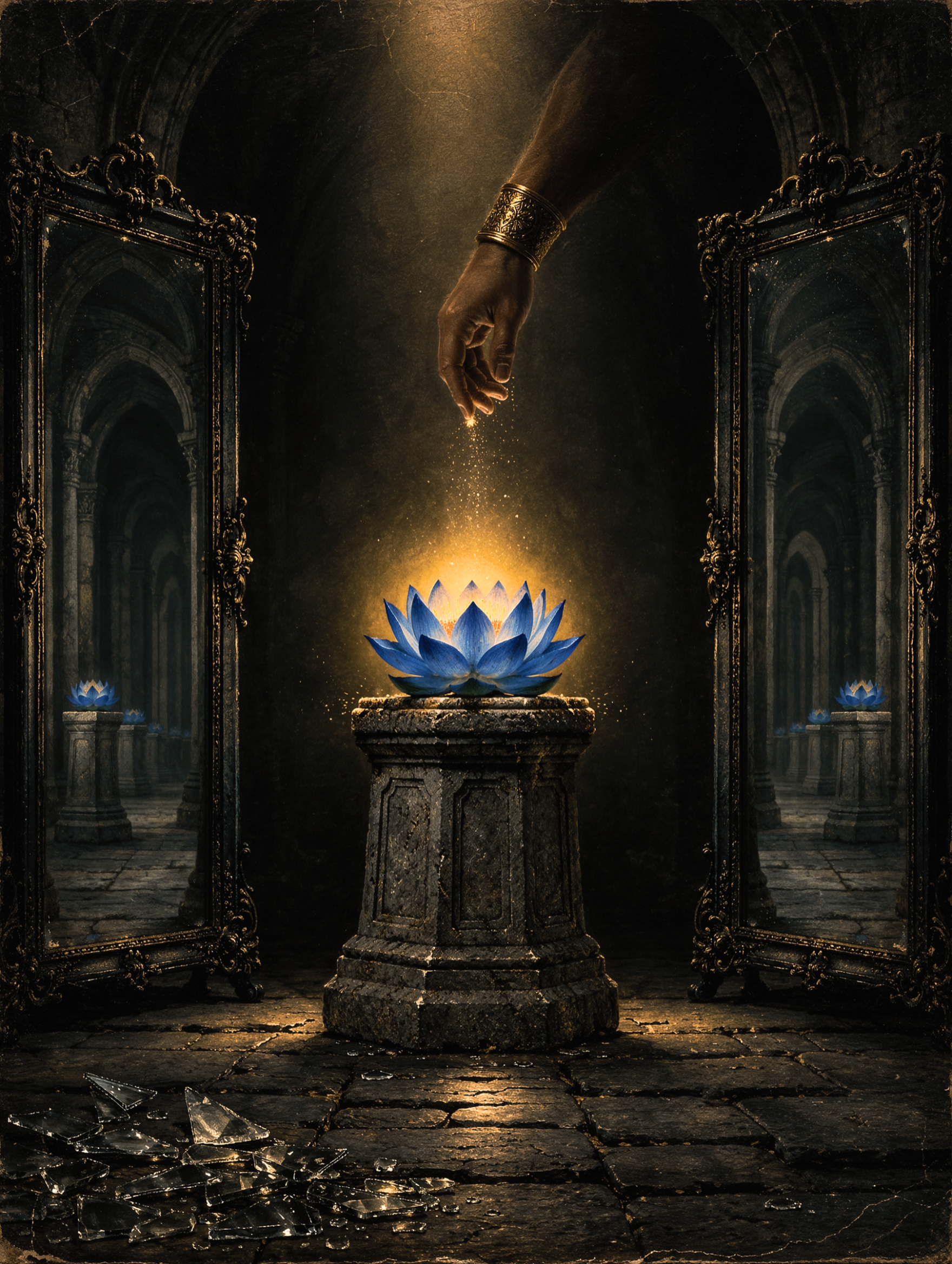
“In principle, a work of art has always been reproducible.”
— Walter Benjamin, The Work of Art in the Age of Mechanical Reproduction
As a child, around nine years old, I was deeply infatuated with Ancient Egypt. Given my health condition, it makes sense in hindsight that I identified so passionately with its intense sense of immortality not as a question but as an absolute. Therefore, I found its ingrained cultural efforts to keep memory alive long after death through mummification and massive monuments to the long-treasured dead to be inspiring.
I remember sitting cross-legged on the floor, reading about Nefertem, the god of the blue water lily, fragrance, healing, and first sunlight, who was born from rising from the dead waters in a blue lotus flower. With a little more research, I learned that other gods, including Atum and Ra, were also said to have emerged from this type of blossom. Perhaps it was a regional or period-specific preference? Later that same day, I read a myth from ancient India in which Brahma, too, is born from a lotus. I put it down to coincidence, a shared reverence for such florals in both regions. But still it sparked a question I have carried ever since: why do narratives and themes repeat across cultures? And what does that mean for heritage?
That question has grown sharper in recent years with the rise of digitization and AI. Not necessarily because I'm an old stick-in-the-mud who prefers everything the old way, but because the meaning at the heart of stories like the lotus birth (their inherent humanness that led to the creation of the story in the first place) can be cheaply and irreparably lost if we lose the human connection and reverence that kept that meaning alive in the first place.
Today, with an M.A. in World Heritage Studies and B.A.s in Anthropology and Asian Studies, I am well-versed in how heritage is made and conserved. For a long time I was, and perhaps still am, deeply intrigued by the frontiers AI and digitization can open, and by the improvements they can bring to medicine and to preservation practice. And yet, as I sit here in my regular café, the notion gives me pause. Heritage is human-centered. At the core of our stories and myths there is traditionally a kernel of wisdom, a flicker of life, and that is what makes them worth carrying on, along with a laugh, a fright, or a fateful conversation.
So what happens when we remove the humanness from our own human heritage? Is our connection to our ancestors lost when we lose respect for the original source? And what does that say about storytelling, museums, and heritage in our modern context? My answer is, in short, that stories have always been copied and changed over and over throughout the millennia, but what keeps them alive as heritage is respect for where they came from and the thought and truth behind it.
Personal Experience:
As a child, and an ill child at that, I spent most of my recesses indoors. I was told it was to keep me safe, but over the years it taught me that it was to keep everyone else safe from the thing that was inherently and irreparably wrong with me.
So, with my hours spent in the library rather than on the playground, I learned to love reading, especially ancient mythology and world history. As I grew older, my tastes naturally grew more refined, and I began seeking out the original texts, or the most faithful translations, which were far more challenging to come by. I would often wait weeks for the books to arrive from the library, and it felt so special, like a mini-Christmas when they finally did, and I could read every word with the attention and respect it deserved.
That need for accuracy was born out of respect for the source and the ones who made it more than modern reinterpretations, and it followed me into my work in heritage and anthropology. As a result, I always did my due diligence: reading the source material and learning the views of locals and the history of a place or idea before offering my own judgment. It was the same with my favorite literary classics, among them Dracula, Frankenstein, Dr. Jekyll and Mr. Hyde, The Count of Monte Cristo, The Phantom of the Opera, The Iliad, and The Odyssey. When I first read them, I was so fascinated by these stories that I delved into the lives and worlds of their authors, just to understand the context, thinking, and culturally specific values behind such novels. All in the hope that one day, I would become an author like them.
Fast forward a few years to when I was working in a bookstore and noticed a slew of ancient historical fiction flooding the shelves. Some were better than others, but too often (I swear to all that is holy) some authors had simply googled "names from [insert time period]" and pasted names and places into periods where they did not belong, with no respect for the culture, place, or period they were writing about. Some had names like “Ankhsenamun,” an extremely high-profile name from a very specific and controversial period, and chucked it into a completely different dynasty with no rhyme or reason or understanding of the origins of the name or the actual historically accurate events of that particular woman’s life. However, instances such as these are not isolated. And have become more common as hunting “trends” outweigh “research” in writing good and unique stories from the heart of the writer. However, as "retellings" and "reimaginings" of classics become increasingly infused with engagement-rich tropes such as the "billionaire," the "elf," or the "alpha" in stories where they just do not belong, I see no end in sight.
But, in theory, all stories are for entertainment, aren't they? Well, yes and no. And to generalize them cheapens the value of narratives and stories as a whole. However, I would argue that the intent of the original is often complicated and culturally specific, depending on time, place, culture, and individual preference. That is what makes the originals unique, just like every person and star in the sky. That's why we miss a deeper understanding in artifacts and classics when we sift the heart away and take only the aesthetics for our own purposes. And what can be said about museums doing the same?
I believe there is, and it is one of the aspects of my field I find most irksome. The balance between respect for the past and entertainment in the present is a battle over which memories get carried into the future. Consider the most recent museum definition, adopted by the International Council of Museums (ICOM) in 2022:
"A museum is a not-for-profit, permanent institution in the service of society that researches, collects, conserves, interprets and exhibits tangible and intangible heritage. Open to the public, accessible and inclusive, museums foster diversity and sustainability. They operate and communicate ethically, professionally and with the participation of communities, offering varied experiences for education, enjoyment, reflection and knowledge sharing." (ICOM, 2022)
It is that final phrase, "education, enjoyment, reflection and knowledge sharing"—that I find both the most intriguing and the most disturbing. Education is there, but nowhere is respect for what is enjoyed, reflected upon, or shared guaranteed, or even mentioned. ICOM's separate Code of Ethics does ask for sensitivity toward human remains and sacred material (ICOM, 2004), but the definition itself, which sets out what a museum is for, does not. Instead, the modern visitor's interests take center stage, while the artifacts, paintings, and sculptures in the collection while the lives they touched, who made them, why, and who those people were come as a distant second. That, to me, is a shame, and it is the centerpiece of this tension between replication and respect.
Historical Transference of Ideas:
There are two broad answers to why the same themes turn up in different cultures. Either people carried them from one place to another, or people in different places arrived at them on their own. The German ethnologist Adolf Bastian (1860) called the second kind Elementargedanken: elementary ideas shared by all humans, which each culture dresses in its own local forms, its Völkergedanken. The lotus births of Egypt and India may well be of this second kind. Even the flower differs: Nefertem's "lotus" is the blue water lily (Nymphaea caerulea), while Brahma's is the sacred lotus (Nelumbo nucifera), a different plant entirely.
It should be said plainly that cultures evolved both separately and connectedly. It is rarely a binary process, and it depends heavily on terrain, trade, and the cultural and religious dynamics between the groups. Where ideas were carried, I see three broad modes: proximity, trade, and force. Each brought change, sometimes subtly and sometimes intensely.
Proximity. Sometimes exchange came softly, simply from living near one another over time, often peacefully, out of open-mindedness and necessity. This is common in valleys, basins, and mountainous regions, such as the Thuringian Forest in central Germany, where separate villages exchanged ideas and lived interconnectedly despite physical barriers, building strong bonds through shared identity. You can see it in the spread of glassmaking throughout the region from Lauscha, where the first glassworks was founded in 1597 (Deutsche Handwerks Zeitung, n.d.). Another example is winemaking along the Rhine Valley. Peaceful exchanges like these produce blended dialects, overlapping folk festivals, and a traceable collective identity among independent groups.
Trade. Trade and the exchange of goods are an equally powerful channel of cultural exchange, visible in webs of trade routes around the world. In the Americas, the Turquoise Road connected Mesoamerica to the American Southwest: turquoise mined in what is now New Mexico was exchanged for copper bells, cacao, and macaws, and with them traveled ideas such as Mesoamerican ballcourts, featherworking traditions, and rituals (Powell, 2005; Cartwright, 2022). In the ancient Near East, the Way of Horus was the main route for the pharaoh's goods, soldiers, and messengers into the Levant (Hoffmeier, 2006), and the Phoenician trade network once dominated the Mediterranean (Markoe, 2000). Through networks like these, pottery and statues of kings and deities spread across whole regions, and so did ideas and beliefs, among god-rulers and ordinary people alike, carried in goods, remedies, and thoughts that shaped their societies.
Force. It would be remiss of me to leave out the darker end of this spectrum, where trade and force blur: the slave trades, from the transatlantic and Indian Ocean trades to the Barbary slave trade (Eltis & Richardson, 2010; Campbell, 2004). These forcibly displaced people across the world, and the ideas and beliefs they carried with them shaped their new societies, sometimes massively, sometimes subtly.
The most forceful channel of all was war, crusade, and conquest, which left more than the dead in their wake. At heart, wars were often fought over culture as much as over land, territory, and values. Those sent to the battlefield, and those who became its casualties, often fought not only to win but to prove one culture superior to another. Sometimes this was for religious, resource, or moral reasons; sometimes it was due to pure, unadulterated ego. But such actions usually came down to a need to sort cultures into superior and inferior. The superior one has its story told; the inferior one gets erased… in theory. In practice, defeat usually led to one of two outcomes. If they lived, they were most often put into servitude to the victor. But if they were killed, the defeated often only survived in the objects they left behind or more subtly in servitude to the other—and those very remnants are frequently what end up behind museum glass.
With these three modes in mind, and with museums and stories now so open and inclusive of all ideas, which are we experiencing in our society today? Ideally, only the first: peaceful exchange that betters communities. I argue, however, that it is a simultaneous mix of all three.
From the perspective of the objects themselves, the museum began as a temple—the Greek mouseion, or seat of the Muses—and at the very least as a respected tool for knowledge. As museums shift explicitly toward being community-centered and entertaining, this creates a direct misalignment with the original intent of the artifacts in their collections. Depending on which way the trending tide blows, an object meant for understanding can even become an object of mockery and ridicule.
The question, I believe, is whether artifacts in museums are subject to the ideals of the living, sitting silently and helplessly behind glass while every shifting opinion about their history, creator, or origin determines their worth.
But that is not the story I see. I see artifacts as testaments to a past that has outlived us, and they deserve to be shown and understood on that principle alone. Condemning or endorsing the dominant ideology of the period in which an object was made misses the deeper point of witnessing human history as it actually was.
This, I believe, is what has been lost in museums in recent years. I will return to the museums topic specifically in later articles, but the question remains: if we claim the right to change the narrative, and the past along with it, what fate does that leave for the artifacts themselves? Do they deserve our respect? Do we deserve theirs?
The Evolution of Replication:
Despite how it may seem, I am not waxing poetic about the good old days. In his essay written in 1935 and first published in 1936, Walter Benjamin points out that copying is nothing new: pupils copied works to practice their craft, masters copied to spread their work, and third parties copied for profit. He then adds that "mechanical reproduction of a work of art, however, represents something new" (Benjamin, 1936/1969, p. 218). And in his time, he was correct. Mechanical reproduction led to a new dawn of potential, unchecked horizons and problems for the industry… just as digitization and AI do in our present age.
What was new, for Benjamin, was the loss of what he called the work's “aura.” Or, to put it simply, its unique presence in time and space, its single existence in one place, and the history it gathers there. Even a perfect copy lacks this. Aura is also bound up with tradition. Art began embedded in ritual, valued for what Benjamin called its cult value; reproduction shifts it toward exhibition value, made to be seen by anyone, anywhere. The same shift describes the museum itself, from temple to exhibition hall. Benjamin was not simply mourning this. He also saw it as freeing art from ritual and opening it to the masses. But I think something is lost along the way, and it is worth naming.
I would argue that digitization, and especially AI, are something new in this process of replication, just as the camera was in Benjamin's day. The camera reproduced the object; AI reproduces the making. It can write books that read as almost human if done well enough, but in doing so it takes the humanity out of the production process, and out of memory-making itself. If mechanical reproduction weakened the aura of the object, AI risks weakening the aura of the story: the human hands, minds, and reverence that carried it to us.
Modern Media:
Modern media include books, film, social media, theater, and any form of entertainment that draws on culture, so it is easy to see how trends here spark replication. If you wander through any bookstore lately, you will likely see repeating themes: narratives traceable to Sarah J. Maas's A Court of Thorns and Roses (2015), historical fiction riding the wave of Madeline Miller's Circe (2018), and a slew of Tudor novels that trace back to the popularity of Philippa Gregory's The Other Boleyn Girl (2001, filmed in 2008). There is a wealth of source material on Irish fairy (aos sí) lore, ancient Greece, and Tudor England, and yet the same few stories repeat themselves.
Take Homer's epics as an example. The Iliad and The Odyssey, composed around the late 8th century BCE, began as oral poetry and were later written down. For centuries, give or take, they were a staple of Western education, taught in antiquity and again in the Renaissance. In a way, the story and its written version are themselves a tradition and a cultural practice.
Now take Troy (2004), Wolfgang Petersen's film of The Iliad starring Brad Pitt. It kept the broad shape of the story but took creative liberties, most notably leaving the gods offstage and keeping the story entirely in the hands of mortals and demigods. That was a creative choice, but it also reflected the values of its time. Move forward to 2026 and Christopher Nolan's The Odyssey, and we see an entirely different face of Homer: gods and monsters on screen, but a far more modern, PTSD-centered telling. Scholars such as Jonathan Shay (2002) have long read Odysseus's homecoming through the lens of combat trauma, yet the film puts that reading at the center in a way the poem does not.
If the originals are so significant, surely these other versions are simply homages to them. But that logic has a problem: in a battle for attention, the homage can outlive the original.
With global literacy challenges still leaving roughly half of primary-school-aged children below minimum reading proficiency (UNESCO Institute for Statistics, 2026), and with every day more a battle for engagement than for depth and quality, who will win the contest between memory, engagement, and relevance? Troy was a massive global hit, grossing $497.4 million worldwide and finishing as the eighth highest-grossing film of 2004 (Box Office Mojo, n.d.). The Odyssey has grossed nearly $1.8 billion worldwide this year (Sacnilk, 2026). And yet reading Homer has surged in popularity not on its own merit, through school requirements or because of its historical significance, but thanks to the blockbuster adaptations that hark back to it and pay tribute to it, however faithfully or unfaithfully (Dunbar, 2026). So the question needs to be asked if culture is just a simple never-ending battle of oppressed and oppressor, and the morally victorious one is the one that is the most popular, then does that mean that Homer’s epics will be overshadowed and eventually forgotten due to the increased popularity of these modern renditions and reimaginings through books and film? Should it be?
What Has Changed:
I believe screen time and the need for instant gratification are at least partly to blame. It takes focus to walk through a museum, read the labels, and pay your respects in deep contemplation of what you are seeing and what it means in the grand scheme of things. But edutainment has taken over the exhibition field, to the point where museum technology has in many ways become synonymous with the exhibition itself. How freely we replicate the past, and how much respect we hold for it, seems to depend on whether we look backward and forward in time or stay rooted in an entertaining present, and on whether our mindset is built for growth or for entertainment.
In our shifting society, it has become our "right" to be "creative" with our heritage, expanding the narrative to become all that we want it to be, often by identifying and condemning the sins of the very ancestors whose artifacts and deeds are immortalized behind museum glass.
As museums have changed so starkly over the past three decades, so has our sense of what belongs to us and what belongs to the sanctuary and respect afforded to the dead. In times long past, death was considered an eternal present, a shadow that walked beside us. Now, blinded by our screens and flashing lights, we barely see the inevitability of death across past, present, and future, because we want to experience and be entertained only by the present.
And this, I believe, is where the true folly of the situation lies: destroying a past that was ours to cherish and understand, claiming a future we cannot fully claim, and leaving the lessons of our ancestors in the dust, sacrificed to our need for the quick and the cheap.
Heritage's Role:
In heritage, what we value becomes what we engage with, and what we engage with is most likely to survive. Whether we mean artifacts, ideas, places, practices, people, or memory, we have to remember our heritage for it to remain an active part of our personal and cultural identity.
My concern is this: what is most likely to be remembered? The hugely popular films, engaged with by default, or the book, the original? Over time, if the new versions become more popular, could they overshadow or even erase the original? If you have ever gone on a wild research goose chase through quotes of quotes of quotes that lead back to a document burned centuries ago, you know the pain of this experience.
These tributes keep Homer's name and the general story alive. But what about the meaning and the soul of it? Will that be sacrificed on the pyres of modern trends as well? Can it be stopped? Should it be stopped? Or is it a natural consequence of time's ever-ticking clock and the impermanence it brings?
Conclusion:
In principle, all art is theoretically reproducible and subject to change. However, if that is the case, then what is the value of a Monet painting or the works of Shakespeare if newer renditions of them are more popular? Stories and art are meant to be shared and to grow their message like ripples in a lake, and, as a natural consequence, to evolve into something greater than before. That is part of why the same themes repeat across cultures, whether they were carried along trade routes or born independently from shared human experience. But there is a core- the soul… the heartbeat, or the aura- that can only be found in the original, which I believe needs to be protected.
My concern is that if these stories become sensationalized with their messages bending to the whims and fancies of modern audiences, the point and soul of the original is in danger of being lost and sacrificed on the altar of presentism. These modernized versions could overshadow it, along with the lessons that made the story so important to so many generations before us, so that the original is smothered and ultimately forgotten by comparison. The fact is that the nature of historical fiction, fantasy, and horror all draw from influences of cultures, people, and places, and sometimes the new version outshines the original. But without the original, the sun to the moon, will the moon even shine on its own, or will the new version be bright enough to leave the other forgotten? I believe the originals need to be remembered, cherished, and incorporated into our modern lives in order to continue to exist and to carry their heart and values into the next generation. With AI now able to reproduce not only the object but the act of storytelling itself, that remembering matters more than ever.
So, if there is a story you love, research the original and look for its artifacts in online collections; if not, visit the sources in person. All stories started somewhere, and that link to our hearts is true living heritage. It is not our place to judge the past, but it is our privilege to understand it and to keep it safe so that the next generation may do the same.
What do you think? Can you relate?
Comment below.
Keep ticking, everybody!
P.S. Are there any aspects of CVD health or pacemakers you'd like to know more about?
Feel free to email me at: blairmueller28@gmail.com
Reference List:
Bastian, A. (1860). Der Mensch in der Geschichte: Zur Begründung einer psychologischen Weltanschauung (3 vols.). Otto Wigand.
Benjamin, W. (1969). The work of art in the age of mechanical reproduction. In H. Arendt (Ed.), Illuminations (H. Zohn, Trans., pp. 217–251). Schocken Books. (Original work published 1936)
Box Office Mojo. (n.d.). Troy (2004). Retrieved November 25, 2026, from https://www.boxofficemojo.com/title/tt0332452/
Campbell, G. (Ed.). (2004). The structure of slavery in Indian Ocean Africa and Asia. Frank Cass.
Cartwright, M. (2022, August 17). Turquoise in Mesoamerica. World History Encyclopedia. https://www.worldhistory.org/article/2053/turquoise-in-mesoamerica/
Deutsche Handwerks Zeitung. (n.d.). Museum für Glaskunst Lauscha: Zerbrechliche Schönheiten. https://www.deutsche-handwerks-zeitung.de/?p=156381
Dunbar, M. (2026, August 3). Nolan's film could make The Odyssey the most sought-after book in the US. The Guardian. https://www.theguardian.com/books/2026/aug/03/the-odyssey-book-sales
Eltis, D., & Richardson, D. (2010). Atlas of the transatlantic slave trade. Yale University Press.
Gregory, P. (2001). The other Boleyn girl. Touchstone.
Hoffmeier, J. K. (2006). "The walls of the ruler" in Egyptian literature and the archaeological record: Investigating Egypt's eastern frontier in the Bronze Age. Bulletin of the American Schools of Oriental Research, 343, 1–20.
International Council of Museums. (2004). ICOM code of ethics for museums. ICOM.
International Council of Museums. (2022). Museum definition. https://icom.museum/en/resources/standards-guidelines/museum-definition/
Maas, S. J. (2015). A court of thorns and roses. Bloomsbury.
Markoe, G. E. (2000). Phoenicians. University of California Press.
Miller, M. (2018). Circe. Little, Brown and Company.
Nolan, C. (Director). (2026). The Odyssey [Film]. Universal Pictures.
Petersen, W. (Director). (2004). Troy [Film]. Warner Bros. Pictures.
Powell, E. A. (2005). The turquoise trail. Archaeology, 58(1). https://archive.archaeology.org/0501/abstracts/turquoise.html
Sacnilk. (2026, October 28). The Odyssey closing box office nears $1.8 billion worldwide. https://www.sacnilk.com/news/the-odyssey-closing-box-office-nears-18-billion-worldwide-to-become-christopher-nolans-highest-grossing-film
Shay, J. (2002). Odysseus in America: Combat trauma and the trials of homecoming. Scribner.
UNESCO Institute for Statistics. (2026). UIS education data [Data set]. https://uis.unesco.org/bdds
#cvd #chd #heritage #museums #book #advice #movie #sociallife #heartfailure #heartproblem #travel #medicine #disabilityawareness #chronicillnessawareness #hearthealthy #medicalprocedure #procedure #cardiac #cardioversion #chronicillness #medicaldanger #medicaldevice #achd #congenital #heartsurgery #cardiology #experience #pacemaker #hope